January 12, 2026
At the Ohio Chamber of Commerce kickoff meeting, Director Stephen D. Dackin offered more than a policy update. He issued a thoughtful and urgent call to action—one rooted in decades of experience across classrooms, school systems, higher education, and state leadership.
Ohio, Director Dackin noted, has much to celebrate. The state continues to be recognized as one of the best places in the nation to do business. Employers are investing. Communities are growing. Opportunity is real.
And yet, the question Ohio’s employers keep asking remains stubbornly the same: Where will our future talent come from?
Naming the Moment
Director Dackin did not shy away from the realities shaping that question. Declining birth rates, an aging workforce, and a shrinking pool of young people entering the labor market are converging at the same time as employer demand continues to rise. Layered onto that challenge is a persistent skills gap—too many students completing K–12 or even postsecondary education without the skills employers most urgently need.
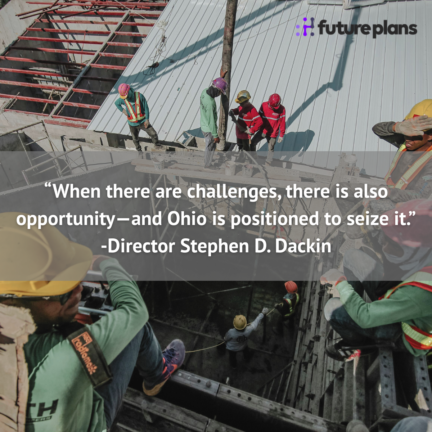
But rather than framing this moment as a crisis, Director Dackin framed it as an opportunity—one that Ohio is uniquely positioned to seize.
The path forward, he argued, lies in coherence.
Not another isolated initiative.
Not a silver-bullet program.
But a more connected ecosystem—one that helps young people understand who they are, what opportunities exist, and how education, credentials, and experience fit together in ways that lead to meaningful work.
Career Awareness as a Moral Imperative
One of Director Dackin’s most powerful messages was also one of the most human: students and families cannot pursue opportunities they don’t know exist.
Too often, career knowledge hinges on zip code, personal networks, or chance exposure. That reality leaves many students—particularly those without strong social capital—navigating critical life decisions with incomplete information.
Director Dackin made clear that career planning should not be optional or incidental. If every student must have a graduation plan, then planning for what comes after graduation should be foundational to that work. Awareness, exploration, and real-world experience belong inside the educational journey, not on its margins.
This belief underpins key priorities of the Ohio Department of Education and Workforce: expanding access to high-quality career-technical education, strengthening work-based learning, elevating durable skills, and making outcomes more transparent for students, families, and communities.
Integration Over Either–Or
Director Dackin also challenged long-standing assumptions about college and career being competing paths. Ohio’s future, he argued, depends on integration—pathways that allow students to earn credentials, build skills, and move fluidly between education and work over time.
Stackable credentials, employer-informed curriculum, and partnerships between K–12, community colleges, universities, and industry are not fringe ideas. They are essential infrastructure. And importantly, they must be visible to students early enough to influence decisions while there is still time to act.
Underlying all of this is respect for educators and an honest acknowledgment of limits. Schools cannot carry this work alone. The ecosystem is too complex. That is why partnerships—across business, philanthropy, workforce, higher education, and social services—are not “nice to have.” They are necessary.
Transparency, Trust, and the Future
Director Dackin also pointed toward the future Ohio is building: clearer measures of workforce readiness, dashboards that show what students do after graduation, improved access to meaningful credentials, and thoughtful guidance around emerging issues like artificial intelligence.
Transparency, he emphasized, serves everyone. Schools deserve clear feedback. Families deserve honest information. And communities deserve confidence that their systems are working on behalf of young people.
Answering the Call
Director Dackin’s remarks crystallized a shared responsibility: to move from fragmented efforts to a system that consistently helps students see opportunity, make informed choices, and build lives of purpose.
Across Ohio, many organizations are answering that call in different ways. Future Plans and PortfoliOH are part of that response.
Developed to support—not replace—the work of schools and partners, the combined Future Plans and PortfoliOH approach reflects the very coherence Director Dackin described: helping students understand themselves, explore real career pathways, document skills and credentials, and carry that story with them as they transition from education into work and beyond.
It is one example of how Ohio’s vision can become operational—not by adding burden to schools, but by connecting existing assets in more intentional ways.
Moving Forward, Together
Director Dackin closed with a reminder that resonates deeply: the resources already exist. What’s required now is alignment, trust, and the willingness to think differently about how Ohio supports its young people.