May 27, 2026
Ohio Senate Bill 328 Signals a Shift Toward Earlier Career Readiness
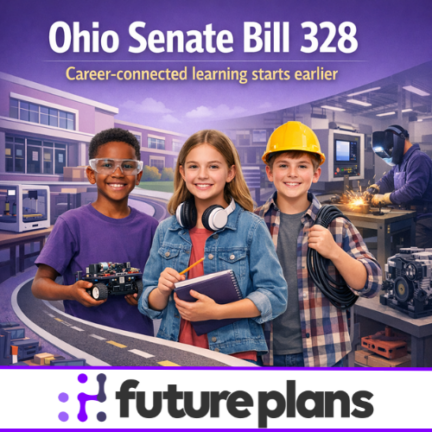
The passage of Ohio Senate Bill 328 (SB 328) signals a clear shift in how the state approaches career readiness and workforce development. Career preparation is no longer treated as a high‑school‑only conversation, but as a developmental process that starts earlier and builds over time, particularly through middle school career‑connected learning.
By embedding career assessment, coaching, exploration, and planning into the middle grades, Ohio is recognizing that students need structured exposure and support before pathways narrow. This approach aligns with growing research and practice showing that early clarity leads to better long-term outcomes.
Why Career Connected Learning Must Start Before High School in Ohio
Too many students are asked to make high-stakes decisions about coursework, credentials, and postsecondary plans without enough exposure to careers, labor market realities, or their own strengths.
When career exploration begins earlier, students are better positioned to understand their interests, see the relevance of coursework, and make more intentional choices as they enter high school. This is especially critical for students in rural, Appalachian, and historically underserved communities, where access to exposure and guidance is often uneven.
What SB 328 Requires — and Why It Matters for districts
SB 328 introduces a more coordinated statewide approach to career-connected learning, including career interest and aptitude assessment in the middle grades, a statewide career coaching framework, hands-on career exploration, required academic and career planning beginning in 8th grade, and a statewide Education and Workforce Return on Investment initiative linking education and workforce outcomes.
Taken together, these provisions move Ohio toward a coherent student journey rather than a set of disconnected activities.
How SB 328 Aligns with the Future Plans Career Development Model
This shift matters because Future Plans’ work is built around these same principles. Our model integrates early, strengths-based assessment, individualized coaching, career-connected learning, and data informed academic and career planning.
By helping students understand who they are, exploring what’s possible, and planning intentionally, Future Plans supports clarity and momentum before students reach high school.
“Through the work at Future Plans and the GRIT Project, we’ve assessed, coached, and helped identify the strengths and aptitudes of more than 20,000 students, keeping Ohio’s talent pipeline moving forward in meaningful ways.” — Dan Leffingwell, Vice President of Community and Government Relations, Future Plans
The Role of Workforce Intermediaries in Implementing SB 328
SB 328 is not simply a compliance requirement for districts. Its success will depend on local implementation capacity and strong partnerships.
Schools, employers, educational service centers, workforce intermediaries, and community organizations all have a role to play. Trusted intermediaries help align systems, reduce fragmentation, and ensure students experience career development as a connected continuum rather than isolated activities.
How Future Plans Helps Schools Turn Policy into Practice
Future Plans is uniquely positioned to support districts as they move from policy to practice. Our human-first, data-driven approach centers on students’ strengths, connects learning to real workforce opportunities, supports earlier and more consistent coaching, and aligns employer engagement with students’ exploration.
This integrated approach helps schools deliver meaningful experiences within existing capacity constraints while strengthening long-term outcomes.
From Policy to Practice: What This Unlocks for Students and Communities
If implemented well, SB 328 has the potential to expand equitable access to career exploration across Ohio, improve transitions into high school through structured planning, strengthen alignment between education and workforce demand, and increase transparency around long-term outcomes.
Most importantly, it creates conditions for students to navigate the future with greater clarity, purpose, and possibility.
Looking Ahead: Building Sustainable Career Pathways in Ohio
The passage of SB 328 reflects a growing recognition that career readiness cannot begin at the edge of graduation. Earlier exposure, stronger advising, and clearer pathway planning must become part of the core student experience.
As Ohio moves from passage to practice, this legislation reinforces what Future Plans sees every day: career development works best when it starts earlier, centers the student, and connects learning to opportunity.
A Note for School Administrators in Ohio
Future Plans is ready to partner with Ohio districts, educational service centers, employers, and community organizations as SB 328 moves from policy to implementation.
If your district or community is exploring how to build earlier, more connected career development experiences for students, we’d welcome the opportunity to collaborate.
Learn more about our approach or connect with us to start the conversation.