April 1, 2026
At the National Association of Workforce Boards Forum, the word alignment showed up everywhere. Across sessions, speakers talked about the urgency facing communities, the pace of change, and the growing need for education, workforce, and employers to work together in new ways.
But agreement on the problem does not always translate into shared practice.
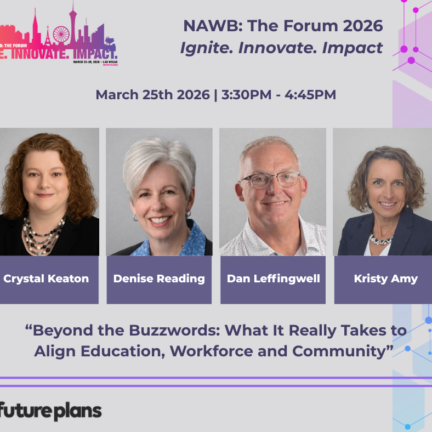
Future Plans’ session, Beyond the Buzzwords: What It Really Takes to Align Education, Workforce, and Community, was designed to slow the conversation down. Not to resist urgency, but to examine what alignment actually requires when communities move beyond theory and into the work itself.
Rather than leading with a model or a set of best practices, the session began with origin stories. Panelists reflected on the moments when incremental change stopped being enough. These were not strategic planning exercises. They were lived experiences, shaped by communities reaching a point where existing systems could no longer meet real needs.
From there, the conversation moved into ownership. Alignment did not happen because a single organization was assigned responsibility. It emerged because unlikely partners were willing to step outside traditional roles and lead differently. Workforce boards, school leaders, and nonprofit partners talked openly about the risks involved in doing things that were not required, not funded, or not clearly defined at the outset.
The session deliberately stayed in what many conference conversations tend to skip. The middle.
This was the part marked by duplication, mistrust, and the fatigue of explaining the same work repeatedly before it gained traction. Rather than framing these moments as failures, the discussion named them a predictable and necessary phase of real systems change. Especially when collaboration crosses institutional boundaries, progress rarely follows a straight line.
Only after that groundwork was laid did the conversation turn toward infrastructure. Panelists described how informal collaboration eventually had to evolve into shared systems, governance structures, and decision-making processes. Not to control the work, but to sustain it. Movements lose momentum when they remain informal. Systems lose meaning when they forget the people who built them. The challenge was becoming both without sacrificing either.
The final portion of the session looked ahead. Scale was not presented as replication or expansion for its own sake, but as the result of alignment that already existed at the local level. When trust, ownership, and shared responsibility are in place, growth becomes possible without forcing it.
The session closed with a simple reflection. The goal was never to create a program. It was to change how communities see themselves and their responsibility to one another.
In a week filled with big ideas and bold language, the conversation offered something quieter and more durable. Alignment is not a buzzword. It is practice. And it is one that communities must choose to own, again and again.