January 20, 2026
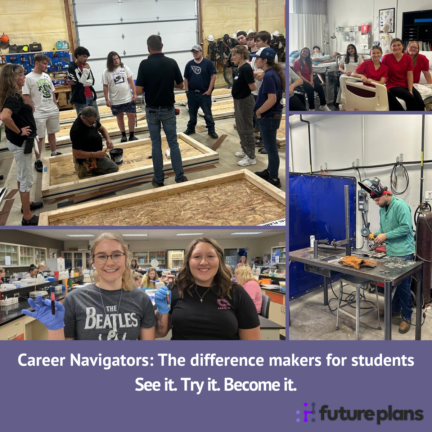
We ended 2025 by bringing over 50 people who work within our local high schools to guide students from high school into career pathways. This role, called a career navigator, serves as a valuable connector between students and local opportunities to the workforce. Each of these schools has committed to starting this process with the Future Plans assessment and career coaching process which helps high school students better understand their career interests, aptitudes, and options. Throughout the discussion, career navigators highlighted how exposure to diverse career pathways—healthcare, engineering, trades, advanced manufacturing, education, cosmetology, public utilities, and more—plays a critical role in helping students align their skills, interests, and long-term goals.
We wanted to share some of these learnings from the frontline support to our future generation of workers.
1. The Assessment as a Foundation for Self‑Discovery
Across schools, career navigators emphasized that the Future Plans assessment and accompanying career coaching session provide students with a structured way to reflect on:
- Their natural strengths
- Their emerging interests
- Career fields they may never have considered
- The link between their preferences and viable job pathways
Several schools noted that students often shift their thinking after receiving their assessment results—discovering that they may be suited for areas like engineering, medical careers, carpentry, or industrial trades even when they originally expected to pursue something else.
2. Exposure to Career Options Is Transformational
A central theme repeated by nearly every career navigator: students cannot aspire to careers they do not know exist. The assessment helps reveal fit, but exposure—through job shadowing, field trips, pre-apprenticeships, and hands‑on learning—cements student confidence and motivation.
Educators shared multiple examples:
- A student who thought he wanted accounting shifted toward engineering after seeing his assessment results and completing job shadowing experiences.
- Students interested broadly in healthcare used their assessment profile to explore pediatric care, hospital environments, or technical programs like STNA and phlebotomy.
- Schools used the assessment to identify students with aptitude for carpentry or flooring installation, leading to an intensive three‑week hands‑on flooring program in a new workforce development center. Many students discovered aptitude they didn’t realize they had—and even began doing paid flooring work in the community afterward.
- Students struggling with attendance rediscovered purpose when introduced to career pathways that motivated them—such as education pre‑apprenticeships or technical training programs.
These experiences demonstrate how awareness + application help students imagine themselves in real careers.
3. Helping Students Connect Interests to Opportunity
Participants consistently described how the skills assessment results guide:
- Who gets invited to participate in specific field trips (e.g., healthcare-focused visits, manufacturing days)
- Which students may be good candidates for apprenticeships in plumbing, pipefitting, electrical work, or cosmetology
- Identification of students who might flourish in technical fields despite academic struggles
- Targeted coaching conversations that address barriers—transportation, confidence, lack of exposure, or life circumstances
Educators noted that many students lack positive adult role models in professional careers. Coaching and exposure help them see a wider horizon.
4. A Systematic, Scalable Approach Across Schools
Schools appreciate that the Future Plans process:
- Creates consistent data for every student
- Allows teachers, navigators, and career coordinators to collaborate
- Brings clarity to elective planning (adding courses aligned to student interest clusters)
- Supports dropout prevention by helping students see purpose in school
- Fosters stronger educator–student relationships through meaningful one‑on‑one coaching
Several schools reported that even students with attendance or behavioral problems became highly engaged once they connected with a career path that energized them.
5. A Regional Movement
Across southern Ohio—rural districts, dropout recovery programs, small schools, and Career Technical Centers—participants are seeing the same pattern:
- When students understand their skills
- When they are shown aligned career pathways
- When they are given the chance to do hands‑on, real‑world experiences
They become more motivated, more confident, and more successful.
If you are interested in learning more about how Future Plans helps communities with workforce development initiatives, contact 216-202-5310 or info@futureplans.org.
GRIT Ohio https://www.gritohio.org/
GIRT Ohio November 2025 Newsletter: https://futureplans.org/grit-ohio-november-2025-newsletter-advancing-opportunity-across-32-counties/