January 22, 2026
Last week’s Reimagine Appalachia conference in Ohio brought together practitioners, rural workforce leaders, and community advocates who shared powerful success stories about reconnecting people to meaningful careers and career programs. Presenters highlighted how many Appalachian residents possess deep, practical skills—often gained informally through family-taught trades, caregiving, manufacturing, construction, and other hands-on work—yet remain overlooked in traditional workforce data
Across Appalachia, conversations about work often start with what’s missing—jobs, industries, and people “left behind.” But when you listen closely to those who understand the region best, a different picture emerges. It’s not simply that people don’t want to work. It’s that many have been disconnected from opportunity through forces far beyond their control.
For decades, prime-age workers—especially men between 25 and 54—have been slipping out of the labor force. National data shows that if Appalachian counties simply matched the current U.S. employment rate, more than 116,000 additional men would be working today. If they matched the participation levels of the mid1960s, the number would be even higher.
These numbers reflect more than economics—they reflect stories. Lives. Families. Entire communities are shifting under the pressure of lost industries, rising health challenges, substance use, unstable wages, and a lack of clear pathways back into fulfilling work.
Yet within these stories lies enormous potential. Appalachia is full of capable, talented people whose skills simply haven’t been matched to the opportunities of today’s economy. And that is where Future Plans is making a transformative difference.

Barriers Are Real, but They Are Surmountable
Presenters spoke candidly about the challenges that keep adults out of work:
- Transportation: Many potential workers simply have no way to get to jobs.
- Digital access and literacy: Applications are online; many workers are not.
- Substance use recovery stigma: People in recovery are often among the most reliable employees, yet they are overlooked.
- Generational patterns: Many pursue the paths they saw growing up, unaware of new options.
- Burnout: Physically demanding industries can leave workers needing time to recover before starting the next opportunity.
- Lack of exposure to career pathways: Many adults know only what they see—often retail and low-wage service jobs.
- Basic logistical barriers: No address, no phone, no email, no transportation—each one is enough to derail a job search.
Future Plans was designed with these realities in mind. Its personalized model meets people where they are and walks with them step by step until they reach sustainable employment or training. It does not assume a lack of ability—only a lack of connection.

Connecting People to Work That Matters
A powerful theme shared by practitioners across the region is that people aren’t just seeking a paycheck—they’re seeking meaning too.
They want:
- work that reflects their skills
- work that feels useful
- work that supports their families
- work that positively impacts their community
This aligns perfectly with Future Plans’ mission. By illuminating each person’s strengths and showing them careers that genuinely fit who they are, Future Plans opens doors not just to employment, but to purposeful, long-term career journeys.
And in a region facing infrastructure upgrades, manufacturing revitalization, and expanding healthcare needs, there is no shortage of meaningful work.

Building a Smarter, People-Centered Workforce System
A recurring frustration among participants in regional workforce conversations is that economic development too often starts with employers and assumes workers will adapt.
But Appalachia is ready for a shift:
Start with the workforce we already have — and find employers who need these people.
Future Plans provides the foundation for that shift by:
- giving communities a clear picture of local skills and strengths
- identifying workers whose aptitudes align with in-demand industries
- supporting schools, apprenticeship programs, and training partners
- connecting individuals to pathways in manufacturing, construction, electrification, healthcare, logistics, and emerging cleanenergy sectors
- helping employers understand the untapped potential around them
This isn’t theory. These are practical, actionable connections happening every day.

A Region on the Brink of Renewal
What emerged from these collective insights is a shared belief: Appalachia does not suffer from a lack of talent. It suffers from a lack of connection, coordination, and consistent support.
The pieces already exist:
- vocational schools with unused facilities after 3 p.m.
- unions eager to train and support new members
- workforce boards with innovative tools and curriculum
- employers who want reliable talent but struggle to find it
- adults with far more skill than their résumés reveal
- community organizations building recovery-friendly workplaces
- young people who need exposure to real career options
Future Plans is the missing connective tissue—an evidence-based system that ties all these pieces together so people can step into stable, fulfilling careers.

The Path Forward
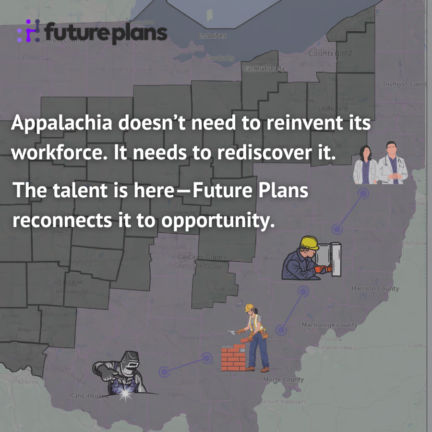
To rebuild the region’s economic future, Appalachia doesn’t need to reinvent its workforce. It needs to rediscover it.
Future Plans is helping people see their value, identify their path, and believe in their ability to contribute to the place they call home.
Because when people are given the chance to work in careers that match their abilities, the entire region grows stronger—families, communities, employers, and the economy itself.
This is not just workforce development.
This is hope translated into action.